Hello! 😊
As our children grow, their oral health is a critical foundation for their overall well-being.
Early Childhood Caries (ECC) is one of the most common chronic diseases globally, affecting hundreds of millions of children.
But here’s the good news: By following these global standard guidelines recommended by organizations like the World Health Organization (WHO) and international dental experts, you can effectively protect your child’s precious primary teeth!
This roadmap will help you establish a strong, lifelong foundation for a healthy smile.

1. 👶🏻 Before the First Tooth: Gum Care is a Must! (Infant Oral Hygiene)
⏰ When to start: You should begin cleaning your baby’s mouth as early as 6 months of age, even if the first tooth hasn’t appeared yet.
✨ How to clean:
After feedings, wrap a clean, damp gauze cloth or use a dedicated oral cleaning wipe on your finger. Gently clean the baby’s gums, tongue, and the inside of their cheeks.
- Key Point: This removes residual milk/formula and helps your child become familiar with oral care, making the transition to a toothbrush much easier later on.

2. 🪥 First Tooth to 36 Months: Laying the Foundation
✅ Start Brushing: Begin toothbrushing the moment the very first primary tooth erupts! Do not delay.
🦷 Recommended Tools:
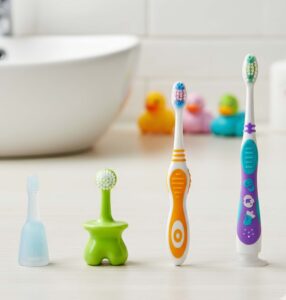
- A soft infant finger toothbrush or a small-headed pediatric toothbrush.
💡 Parent’s Crucial Role (Most Important!):
While it’s great for kids to try brushing themselves, their fine motor skills are not fully developed.
- Essential: Parents must perform a thorough final brush at least once a day (especially before bedtime) until the child is 7 to 8 years old. This step is crucial for guaranteed cavity prevention.
3. ⚠️ Critical Issues: Baby Bottle Tooth Decay & Primary Tooth Treatment
🚨 Preventing Baby Bottle Tooth Decay
- The Cause: This decay occurs when a child sleeps with a bottle (containing milk, formula, or juice) or breastfeeds/sips frequently over long periods.
- Prevention Tip: It is generally recommended to stop nighttime feedings around the age of one year. At bedtime, offer only water instead of milk, or ensure the mouth is cleaned thoroughly after the final feed. (The WHO advises avoiding frequent or prolonged nursing after 12 months, especially at night.)
🚨 Why Treating Cavities in Primary Teeth Matters
- The Reality: Neglecting decay in primary teeth can lead to pain, difficulty eating and speaking, and major problems with the permanent teeth, including inadequate space for them to erupt properly.
- Remember: Primary teeth have thinner enamel than adult teeth, so cavities can progress very rapidly! Regular dental check-ups are vital for early diagnosis and intervention.

4. 🧪 Smart Toothbrush and Toothpaste Selection (International Guidelines)
| Item | Selection Criteria |
| Infant/Toddler Toothbrush | Select a brush with a small head and very soft bristles. |
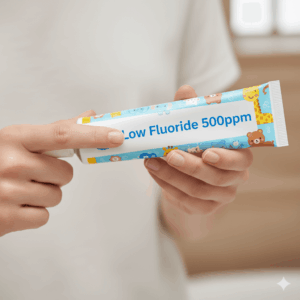
| Fluoridated Toothpaste | Fluoride is the most effective ingredient for cavity prevention. Check the fluoride concentration (ppm) and use it according to your child’s age. |
💊 Fluoride Toothpaste Usage and Amount (Global Recommendation)
| Age | Amount of Fluoride Toothpaste |
| Under 3 Years Old (First Tooth to 3) | A smear or the size of a grain of rice (minimal amount) |
| 3 to 6 Years Old | A pea-sized amount |
| Fluoride Concentration | Dentists often recommend using toothpaste with a fluoride concentration of 1,000 ppm to 1,500 ppm. |
- How to Use: Children must be supervised to ensure they spit out the toothpaste and do not swallow it. After spitting, encourage them to limit rinsing to allow the fluoride to remain on the teeth for maximum benefit.
5. 🛡️ Maximum Protection: Professional Preventive Care
✔️ Professional Fluoride Application (Varnish):
- Effect: High-concentration fluoride is applied to the tooth surface to strengthen the enamel and reduce the risk of decay.
- Recommendation: For children assessed as high-risk for cavities, a dental professional may recommend this treatment every 3 to 6 months.
✔️ Dental Sealants (Pit and Fissure Sealants):
- Principle: A protective coating fills the deep grooves on the chewing surfaces of the molars, blocking access for bacteria and food particles.
- Crucial Timing: This is highly recommended for the first permanent molars (the “Six-Year Molars”) as soon as they fully erupt, usually around age six.
6. 🗓️ Global Standard: Dental Visits and Establishing a ‘Dental Home’
International dental bodies emphasize the importance of early dental visits to establish a preventive routine.
| Item | Universal Recommended Timing | Key Detail |
| First Dental Visit | When the first primary tooth erupts, or no later than the child’s first birthday (Age 1). | This establishes a ‘Dental Home,’ ensuring the child has a consistent source for comprehensive, continuous oral healthcare. |
| Routine Check-ups | Every 6 months (Twice per year) is the general standard. | This frequency applies to children with a low to moderate risk of cavities. If the child is at higher risk, the dentist may recommend shorter intervals (e.g., every 3-4 months). |
| Purpose of Visit | To receive regular check-ups, professional fluoride application, risk assessment, and personalized parent education. | Prevention and early detection are the primary goals, not just fixing problems. |

Starting these practices early ensures a lifetime of optimal oral health for your child.
Don’t wait until there’s a problem—prevention is the best medicine!