Have you ever found yourself wondering, “Why does my child act this way?”
Some children dive fearlessly into new experiences, while others become anxious about the smallest change.
The reason children react so differently, even when raised the same way, often lies in their “innate temperament.”
If you want to understand your child for who they truly are and start a personalized parenting journey tailored to their unique traits, let’s explore the ‘TCI Temperament Test.’
What is the TCI Temperament Test?
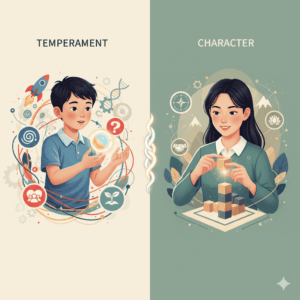
The TCI (Temperament and Character Inventory) is a psychological assessment tool designed to comprehensively measure both Temperament and Character.
- Temperament: Refers to the biologically inherited and automatic emotional reaction tendencies. These traits are stable throughout one’s life and do not easily change.
- Character: Refers to personality qualities that develop through conscious effort, environment, and life experiences, such as values and goals. This is the part of the personality that individuals can actively change and grow.
By measuring these two distinct components, the TCI test goes beyond simple behavioral patterns to provide a detailed and sophisticated understanding of an individual’s thought patterns, emotional style, behavioral habits, and interpersonal dynamics.
What Can a Temperament Test Reveal?
The TCI evaluates an individual’s personality across seven dimensions, with a specific focus on understanding a child’s innate temperamental traits.
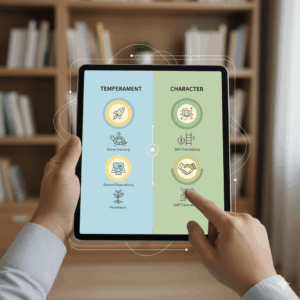
| Category | Scale | Key Characteristics |
|---|---|---|
| Temperament (Innate Traits, 4 scales) | Novelty Seeking | Tendency to be attracted to new things, enjoy exploration and excitement. |
| Harm Avoidance | Tendency to avoid danger or aversive stimuli, resulting in behavioral inhibition (worry, anxiety). | |
| Reward Dependence | Tendency to be sensitive to social reward signals like approval and emotional support from others. | |
| Persistence | Tendency to continue behavior steadily even when immediate rewards are not given (determination, grit). | |
| Character (Developed Traits, 3 scales) | Self-Directedness | The ability to set goals and regulate one’s behavior (responsibility, self-control). |
| Cooperativeness | The ability to get along harmoniously with others and be accepting (empathy, collaboration). | |
| Self-Transcendence | A characteristic of feeling interconnected with the universe beyond the self (spirituality, creativity). |
Through the test, you can gain essential insights into what stimuli your child is sensitive to, how they tend to react emotionally, and what situations cause them stress.
When (At What Age) and How to Take the Test?
🗓️ Test Timing
The TCI test is suitable for a wide range of ages, from preschoolers (age 3) to adults (60+).
- Infancy/Childhood (Ages 3 to 11): Taking the test early, during the formation of the child’s temperament, helps parents quickly understand their child’s reaction patterns and implement personalized parenting strategies.
- Adolescence: During the formation of self-identity, understanding one’s temperament and character objectively can aid in career exploration and self-understanding.
- Parents: It is often highly recommended for parents to take the test themselves to understand their own temperament and character, which is crucial for recognizing their interaction style and parenting approach with their child.

📝 Test Procedure
- Preschool (Ages 3-6) and Child (Ages 7-11) Versions: Parent-Report (The parent observes the child’s typical behavior and answers the questions).
- Adolescent (Ages 12-18) and Adult Versions: Self-Report (The individual directly answers the questions).
- Duration: Typically takes about 15 to 30 minutes, and can be conducted online or in person.
💡 Parental Objectivity is Key!
When taking the child version, the parent’s current stress level or emotional state might influence the results. It is important for parents to answer the questions about the child’s behavior objectively and honestly during a relatively calm period to ensure accurate results.
How to Utilize the Temperament Test (Parenting Strategies)
The temperament test should be used not to find ‘flaws’ in the child, but to accept their ‘innate characteristics’ and help them develop their strengths.
- Understand the Root of Behavior: You learn that your child’s challenging behaviors are not just ‘stubbornness’ but stem from their innate temperament. For instance, a child with high ‘Harm Avoidance’ may be viewed as ‘cautious’ instead of ‘timid.’ This allows you to offer security first, rather than pushing for immediate challenges.
- Tailored Communication and Motivation: Children are motivated by different types of rewards based on their temperament.
- High Reward Dependence: Highly motivated by emotional rewards like praise and acknowledgment.
- High Novelty Seeking: Motivated by the activity itself—something new, exciting, and fun.
- Review and Adjust Parenting Style: Conflicts can escalate when the parent’s and child’s temperaments clash. By understanding their own temperamental traits, parents can consciously work to change their ‘Character’ dimensions (Self-Directedness, Cooperativeness) in their parenting approach to better align with the child’s needs.
- Strength-Based Parenting: Reframe innate temperament traits as ‘strengths’ rather than ‘weaknesses’ to boost the child’s self-esteem. (e.g., Praising a child with high Harm Avoidance for being ‘detail-oriented and planning-focused’).
🌐 Where to Take the TCI Test
The TCI is a specialized psychometric instrument.
For accurate results and professional guidance, it must be administered through institutions affiliated with or staffed by certified psychological counselors, clinical psychologists, or trained professionals.
The quality of the interpretation session is just as vital as the test itself.
- Local Counseling Centers (e.g., Dongtan, South Korea): Look for Child/Adolescent Psychological Counseling Centers .
- University and Hospital Clinics: University student counseling centers or psychiatric departments at major hospitals often utilize the TCI for psychological assessments.
- Online Psychological Testing Platforms (Global): Many professional psychological practices or wellness organizations worldwide offer the TCI online. You typically receive a test link and then have a remote (video conference) interpretation session with a qualified professional.
- Crucial Tip: Always ensure the service includes a professional interpretation session from a certified practitioner. Simply receiving the scores alone is insufficient for effective parenting application.
- Anthropedia Foundation: As the organization founded by the TCI developer, Dr. C. Robert Cloninger, Anthropedia offers related training and resources, often connecting users to authorized practitioners globally.
(Note: Specific names of individual centers are omitted for a global audience, as local availability changes. Searching “TCI psychological assessment [Your City/Country]” is the best way to find local providers.)
Common Myths and Misconceptions About Temperament Testing
❌ Myth 1: The temperament test determines a child’s ‘fate.’
✔️ Fact: Temperament is merely a ‘tendency,’ not the whole child. While temperament is highly stable, Character can be developed healthily through environment, education, and parental guidance. Do not treat the results as a ‘fixed label,’ but as a ‘reference map’ to support your child’s growth.
❌ Myth 2: High or low scores on any temperament scale are ‘good’ or ‘bad.’
✔️ Fact: The TCI scales are value-neutral. A low score on ‘Persistence,’ for instance, isn’t a ‘defect’; it might simply mean the child responds better to immediate reinforcement strategies to stay motivated. Every trait can be a strength or a vulnerability depending on the situation.
❌ Myth 3: I can fully understand my child just by reading the test report.
✔️ Fact: A psychological test is merely a tool that compresses a large amount of information. It is risky to define a child solely by the scores. You must conduct an interpretation session with a professional to integrate the test results with the child’s daily behavior and emotional state for a comprehensive understanding.
💖 Conclusion and A Word of Caution
The TCI temperament test can be an excellent compass on your journey to deeply understand your child. By grasping their innate traits, you can reduce recurring conflicts and misunderstandings that arise from parenting approaches mismatched to your child’s nature.
However, the test results must never become a limiting label for your child. Understanding and accepting temperament is the start; nurturing the Character dimensions (Self-Directedness, Cooperativeness) is the crucial role of the parent.Do not rely too heavily on the results, thinking, “My child is just like this,” or box them into a specific type. I urge you to use the test results as ‘a new perspective to love your child as they are.’ Children thrive best when they receive their parents’ warm understanding and appropriate support.